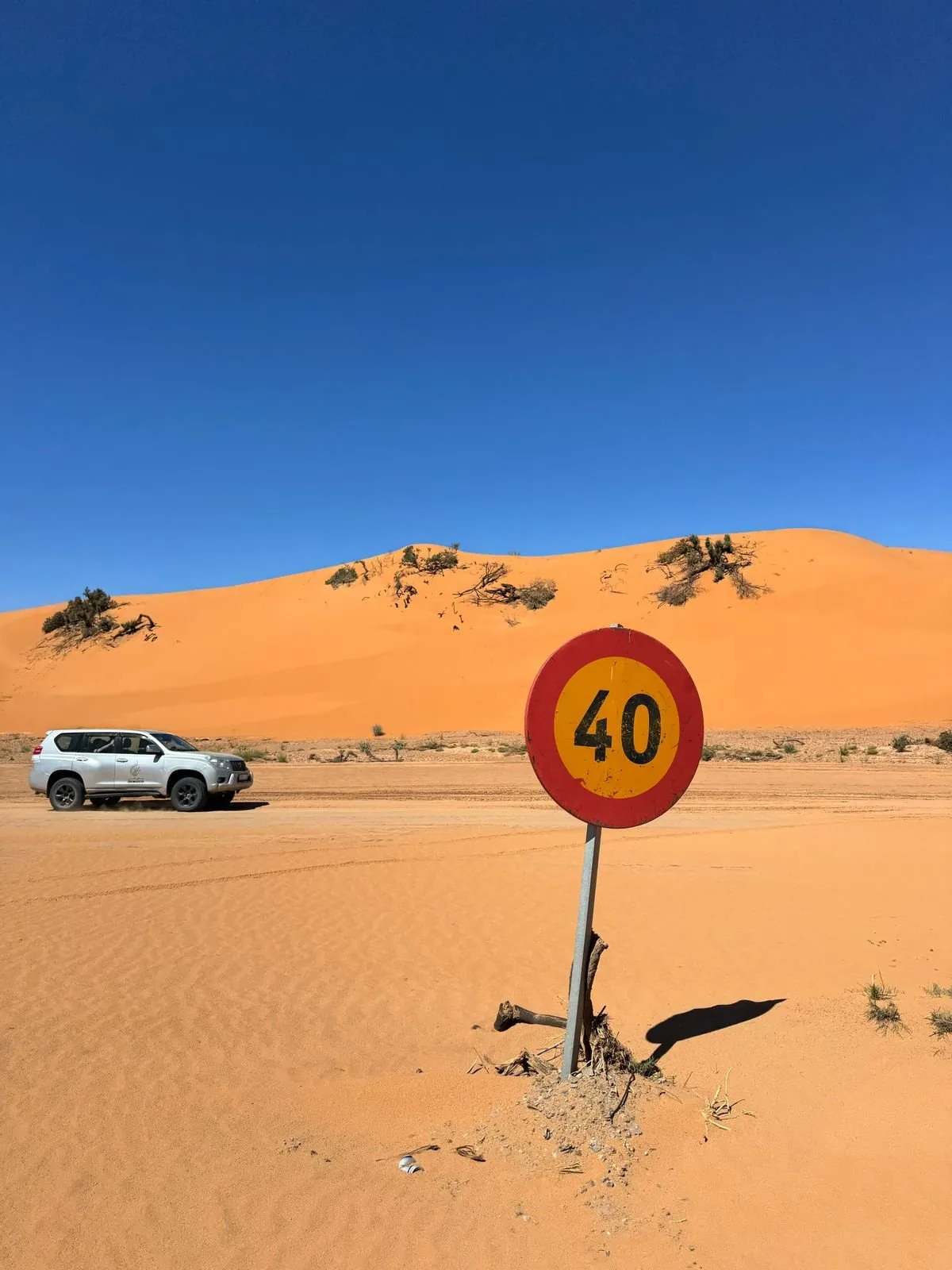
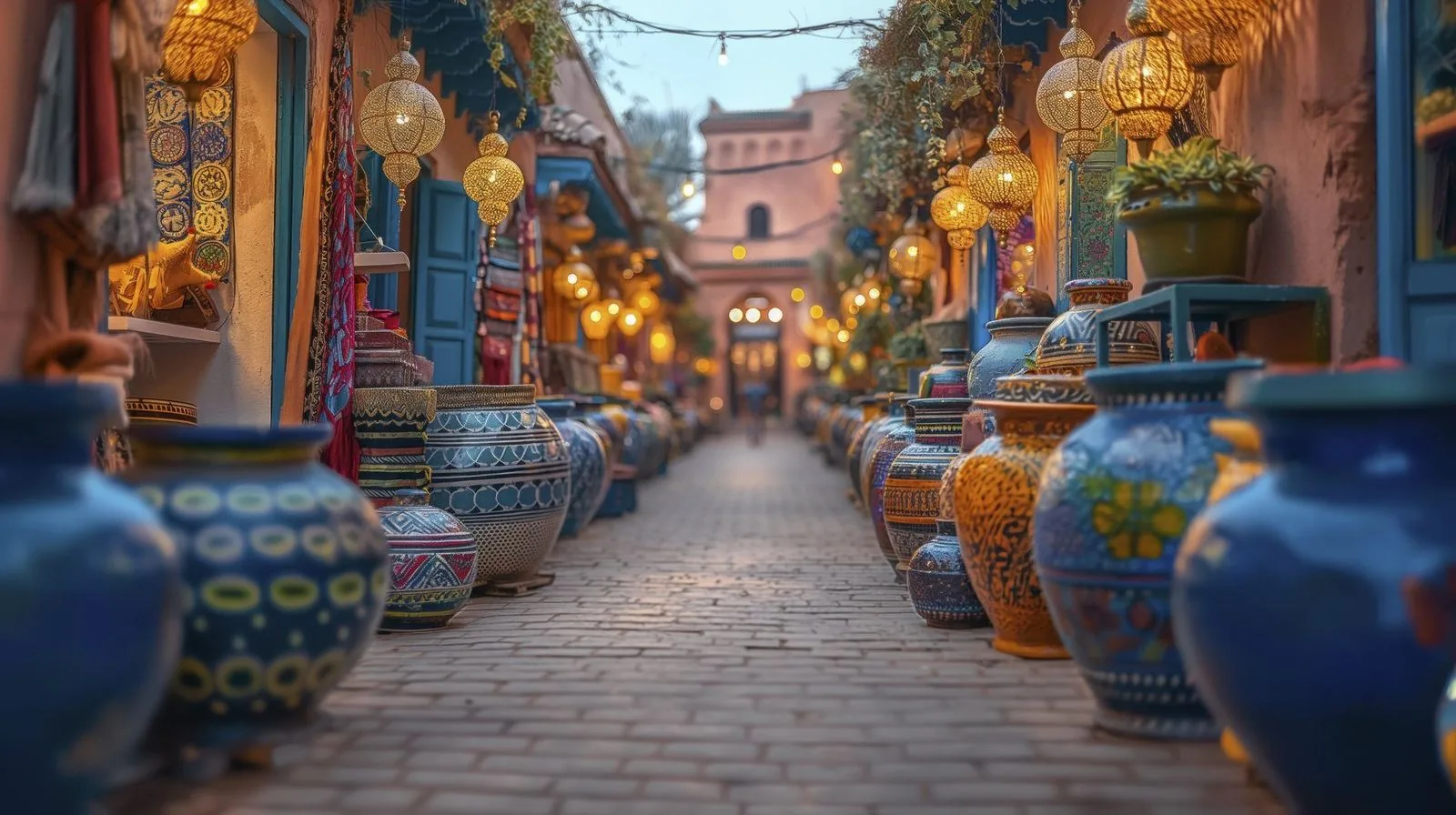
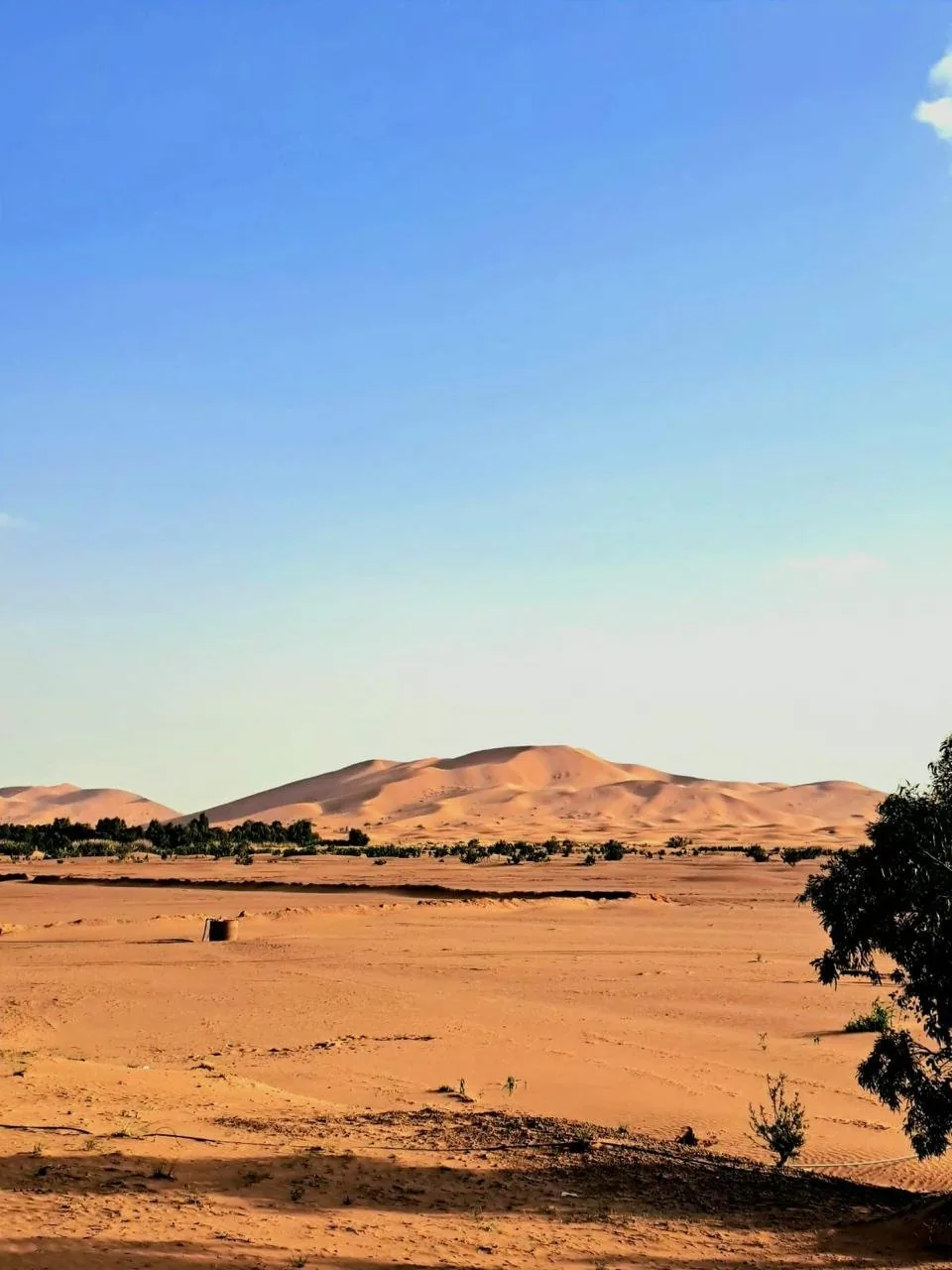
You've seen the photos: golden dunes stretching to the horizon, camel silhouettes against a burning sunset, a tent under a billion stars. The Sahara desert tour from Marrakech is the trip that brings travelers to Morocco — and it's our home. We're an Amazigh (Berber) family, born and raised in Erfoud, on the edge of the dunes. We've been guiding travelers from the Red City to Merzouga for over 12 years.
This guide answers every question we get asked: How many days? Which route? What does it really cost? Is it worth it in summer? What should I pack? Is it safe? No marketing fluff. Just honest local advice — from the family who lives there.
The Sahara at a Glance
The Moroccan Sahara most travelers come to see is the Erg Chebbi, a 28-km stretch of golden dunes near the village of Merzouga, on the Algerian border. From Marrakech, the drive is roughly 560 km (10 hours) — too far for a single day. The minimum to genuinely experience the dunes is 3 days / 2 nights; the most rewarding is 4 to 5 days.
👉 Quick answer: The classic and most-booked tour is 3 days / 2 nights from Marrakech to Merzouga and back. It includes the High Atlas, Aït Benhaddou (UNESCO), Dadès gorges, the Erg Chebbi dunes, a camel ride and a night in a desert camp. From there, every day added means more depth, less highway.
How Many Days Do You Really Need?
3 Days / 2 Nights — The Classic
The most popular option, and an honest one. You leave Marrakech in the morning, sleep one night in a kasbah near Aït Benhaddou or in Dadès, then reach Merzouga on day 2 for sunset camel ride and overnight in the dunes. Day 3 is the long drive back to Marrakech (about 10 hours including stops).
Honest verdict: 3 days is enough to see the dunes and feel the magic. The downside? Day 1 and Day 3 are long driving days. If you have only 3 days, do it. If you can stretch to 4 or 5, you'll thank yourself.
4 Days / 3 Nights — Our Favorite Balance
Same route as the 3-day, but with an extra night that lets you slow down. We recommend adding the night in Dadès and a second night in Merzouga (one in the camp, one at a hotel near the dunes). This way you get sunset, sunrise, and an extra morning to do quad biking, visit Khamlia village for Gnawa music, or just rest with mint tea.
5 Days / 4 Nights — The Deep Dive
For travelers who want more than the highlights. With 5 days we add a side trip to the Drâa Valley palm groves, time in Todra gorges (incredible for hiking), and a stop in Skoura's palmeraie. You sleep in unique places: a kasbah, a riad in the desert, a luxury camp in the dunes. This is the trip people come back from changed.
One-way — Marrakech → Merzouga → Fes
An option many travelers miss: instead of looping back to Marrakech, end your tour in Fes. Same scenery for the first 3 days, but on day 4 you cross the Middle Atlas (cedar forests, Barbary apes near Azrou, Ifrane) and arrive in Fes. Saves 8 hours of driving and adds a major imperial city. Perfect if you fly out of Fes-Saïss airport.
The Route, Day by Day
This is what the classic 3-day tour looks like, the one we run most often:
Day 1 — Marrakech to Dadès
Pickup from your Marrakech riad around 7:30am. We climb the High Atlas via the Tizi n'Tichka pass (2,260m), with photo stops at the most scenic points. Lunch in Telouet or Aït Benhaddou. The afternoon is spent at Aït Benhaddou kasbah — a UNESCO site you've seen in Gladiator and Game of Thrones. Continue through Ouarzazate ("Hollywood of Africa") and the Valley of a Thousand Kasbahs to Dadès for the night.
Day 2 — Dadès to the Dunes
The most beautiful driving day. Through the dramatic Dadès gorges (look for the rock formations called "Monkey Fingers"), the Todra gorges (300-meter cliffs above a narrow river), the date palm oasis of Tinghir. Lunch on a riverbank. Mid-afternoon arrival in Merzouga, where your camels and a Berber camel guide are waiting. We ride into the dunes for sunset, with mint tea served at the top of the highest dune. Night in a desert camp — a tagine dinner, music around the fire, a bed under the stars.
Day 3 — Sunrise & the Long Road Back
Up before dawn to climb a dune and watch the sun come up over the sand. Camel ride back to your 4x4 around 8am, breakfast at a hotel near the dunes. Then we begin the long drive back: same route in reverse, but with different stops — fossil mines in Erfoud, Berber pottery cooperatives in Tamegroute, a long lunch in Ouarzazate. Arrival in Marrakech around 8pm.
What Does It Cost?
Every tour is private and fully personalised — pricing depends on group size, choice of accommodation, season, and duration. For that reason we prefer to send you a tailored quote rather than a generic range that wouldn't reflect your actual trip.
What we commit to: all-inclusive pricing (4x4, driver-guide, accommodation, listed meals, activities), no hidden commissions, no surprise charges on arrival. The quote you receive is the final price.
Private vs group: we operate private tours only. Your own 4x4, your own pace, real stops where it matters (a women's pottery workshop, an extended sunset, mint tea with our Berber cousins). 12-passenger minibus tourism doesn't tell the same story we want to.
Request a personalised quote WhatsApp · reply within 1h
When to Go?
October – April: The Perfect Window
This is when the desert is at its best. Days are warm (20–28°C), nights are cool (4–12°C, sometimes below 0°C in January). Mornings and sunsets are golden, the light is incredible. October, March and April are our personal favorites: warm enough to be comfortable, not yet too cold at night.
May & September: The Shoulder Months
Still very doable. May days reach 35°C but nights are pleasant (18–22°C). September starts hot but cools fast. Fewer tourists, lower prices, beautiful light.
June, July, August: Be Honest with Yourself
The dunes can hit 45–48°C at midday. We don't refuse summer bookings, but we adapt: very early starts (6am), long midday breaks, swimming pools at hotels, sunset camel rides moved later (8pm). It's still magical — but if you don't tolerate heat, pick another season.
What to Pack
The desert temperature swings from hot day to cold night. Layers are everything.
- Closed shoes for the hike to the dunes (sand burns at midday, cools at night)
- Light cotton clothes for the day (long sleeves protect from sun better than tank tops)
- A warm fleece or jacket for the night, even in summer
- A scarf or chèche — your driver will probably show you how to wrap it Berber-style for the camel ride
- Sunglasses and sunscreen (SPF 50, the desert sun is brutal even in winter)
- A small backpack for the night in the camp (your big suitcase stays in the 4x4)
- A power bank — most camps have solar electricity but limited
- Cash in dirhams for tips, drinks, souvenirs (no ATMs in Merzouga)
What is the Desert Camp Really Like?
"Desert camp" can mean very different things. There are three categories:
- Standard camp: shared bathroom, basic mattress, group dinner. Authentic but rustic — fine for adventurous travellers on shorter trips.
- Comfort camp: private tent with private bathroom, real bed, hot water, included dinner with traditional music. The best ratio for most travellers, what we recommend by default.
- Luxury camp: spacious tent with king bed, designer bathroom, gourmet dinner, sometimes a private dune. Worth it for honeymoons or special occasions.
All our tours use comfort camps by default. We can upgrade to luxury for honeymoon trips or special occasions — just ask in the quote request.
What About Agafay Desert?
Quick clarification for Marrakech visitors: Agafay is not the Sahara. It's a rocky desert 45 minutes from Marrakech — beautiful in its own way, perfect for sunset dinners or a one-day escape, but it has no sand dunes. Agafay is great for travelers with only one day. Merzouga is what people picture when they say "Sahara".
Is It Safe?
Yes. Morocco is one of the safest countries in North Africa, and the route from Marrakech to Merzouga is well-traveled and policed. Our drivers are licensed professionals; the 4x4 vehicles are maintained and insured; the camps work with local Berber families who have hosted travelers for decades. We've been doing this for 12 years and have never had a serious incident. Read more in our honest safety guide.
Why Book with a Local Family Operator?
The Marrakech-Merzouga circuit is sold by hundreds of agencies online. Most are intermediaries based in Marrakech who outsource to a local network. The price you pay includes their margin and ours. By booking directly with a Merzouga-based family like ours, you cut the middleman:
- Lower price for the same quality (or better quality for the same price)
- Direct contact with the people who actually run your tour
- Money stays in the local Amazigh community
- Custom changes are easy — you talk to the decision-maker
- We know every kasbah owner, every camp host, every cook on the route by name
Quick FAQ
Can I do this tour with kids?
Yes. We've taken children from age 3 to 15. Kids love the camel ride and the dunes. The long driving days can be tough — bring entertainment, snacks, and accept extra stops.
Can I sleep in the dunes if I have back problems?
Comfort and luxury camps have real beds with proper mattresses. Tell us in advance and we'll book accordingly.
Do I need a 4x4 or is a regular car enough?
The road to Merzouga is paved. A regular car is technically possible. But we always use 4x4s because: (1) some kasbahs and viewpoints are off-road, (2) suspension is much better for long drives, (3) it's safer in winter on Atlas passes if there's snow.
Can I customize the trip?
Absolutely — every tour we run is private and custom. Want to add Essaouira, skip Aït Benhaddou, sleep two nights in Dadès, do a cooking class? Just tell us. WhatsApp us and we'll build it.
Ready to Go?
We've guided over 3,000 travelers through this route. Our family team will design your perfect Sahara tour from Marrakech — no commitment, no payment up front, free quote within 5 minutes.